
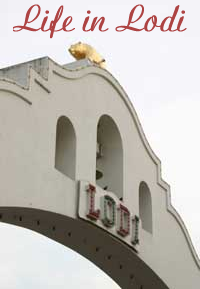
 I have an ongoing love-hate relationship with “the little village of Lodi,” as Paul Zimmerman referred to it regularly when writing about local events in the Lodi News-Sentinel while I was growing up here in the 1960’s and ’70’s.
Last night was our annual “Celebrate America” event at Hutchins Street Square. You couldn’t ask for a more patriotic, wholesome exemplification of the American spirit. Local residents and their guests gather on the lawn of the community center that literally rose from the ashes of our beloved former Lodi and, later, Tokay High School — the campus from which I graduated in 1974 — with their lawn chairs and picnic baskets. They wave flags, blow bubbles, toss around Frisbees and footballs, eat hot dogs and apple pie, gossip about each other, discuss the weather, and stand when the Knights of Columbus and Boy Scouts present the colors. Attendees jump to their feet and place their hand over their heart again when the Lodi Fire Department hoists a giant American flag from its ladder truck and the National Anthem is played.
The more freedom we enjoy, the greater the responsibility we bear, toward others as well as ourselves. (Oscar Arias Sanchez)
The festivities kick off at 5:00 p.m. with an hour or so of music from the Lodi Community Band in which I have a great time playing my flute before joining my family and friends on the lawn to enjoy the rest of the evening’s events. We surrender the stage to a group of local women who tap dance in bedazzled shirts and culottes to “Can’t Smile Without You” by Barry Manilow and a few other tunes from the same genre. The show is usually capped off with a performance by a military band from a nearby base. By the time the sun sets, we are en route back to the car with our folding chairs, ice chests, and other gear.
As I sat on the lawn last night surveying the crowd, I reflected on what it was like growing up in Lodi. My experiences could be described as quintessentially small-town American. I walked or rode my bike to the neighborhood school; participated in extra-curricular activities including band and choir; took piano lessons; worshiped in the local Lutheran congregation with my parents each Sunday;took swimming lessons; participated in summer band and the annual reading challenge sponsored by the public library; and stayed out of trouble. My late-teen and early-twenties rebellions were mild and short-lived.
But all was not idyllic. And I found myself thinking, as I looked at the crowd gathered last night, about the ugly underside of Lodi — and other small towns like it — that existed when I grew up here. And to a much lesser degree, still exists today. It was that other aspect of life in Lodi that fueled my career choice and continues on several levels to inspire me daily, even as I write this article in the living room of the house in “Livable, Lovable Lodi” that my parents built in 1959. This house represents the acquisition of a key aspect of their American dreams, the other major component being, of course, their daughters’ attainment of advanced degrees.
During my childhood, the nation was in turmoil. The war in Viet Nam and social changes marked the 1960’s. I watched events such as the August 28, 1963, march on Washington, D.C., led by Dr. Martin Luther King, Jr., in this room on our family’s black and white television. On that date, Dr. King declared from the steps of the Lincoln Memorial that “[n]ow is the time to open the doors of opportunity to all of God’s children. Now is the time to lift our nation from the quicksands of racial injustice to the solid rock of brotherhood.” Less than one year later, America took a giant step toward equality for all when President Lyndon B. Johnson signed Title VII of the Civil Rights Act of 1964, into law. The Fair Housing Act (Title VIII of the Civil Rights Act of 1968) was enacted four years later.
Dr. King longed for an America where his “four little children will one day live in a nation where they will not be judged by the color of their skin, but by the content of their character.” Assassinated in 1968, he did not live to see a day when “little black boys and black girls will be able to join hands with little white boys and white girls as sisters and brothers.”
Asked in 1995 to evaluate what progress America had made toward achieving the “American Dream” for all, Rosa Parks opined that “[w]e still have a long way to go, we still have many obstacles and many challenges to face. It’s far from perfect, and it may never be, but I think as long as we do the best we can to improve conditions, then people will be benefited.”
While Dr. King was marching on Washington, women were speaking up and out in their quest for equality, and men and women of all colors were protesting a war they could neither understand nor endorse, many Lodians were happily oblivious to the changes sweeping through American cities. Shamefully, Lodi was a town known in those days for its racism, bigotry, and out-of-step citizens. There were no African-Americans in the Lodi classrooms where I was educated during that time period, nor did we have any neighbors of color. By the time that I graduated from Tokay High School in 1974, only two of my classmates were African-American – and neither of them resided within Lodi, but were bused to Tokay from north Stockton.
During my childhood, public school holiday celebrations did not incorporate Hanukkah, much less Kwanzaa or the Winter Solstice, and there was no distinction drawn between secular and religious Christmas observances as is routine in school festivals today. We did not have a spring break. We had an “Easter vacation,” the underlying assumption being, of course, that everyone commemorated Easter. Our textbooks did not celebrate diversity – we were weaned on “Dick,” “Jane,” and similar unabashedly white role models. I recall with humiliation the day I repeated a comment made by my mother in reference to World War II to a classmate of Japanese descent who gently explained its significance to me.
We stand for freedom. That is our conviction for ourselves; that is our only commitment to others. (President John F. Kennedy)
And I still vividly recall the day in 1989 when my oldest son was playing with his toys on the kitchen floor while his father and I prepared dinner. He began reciting a counting rhyme we had not heard since our own childhoods. Momentarily terrorized, I looked over at BigBob and saw the same horrified expression on his face. Time seemed to stand still when, unaware of his parents’ interest in his activity, he began singing “Eeny, meeny, miny, moe . . . “
At that moment, I was catapulted back to my own Lodi childhood when my friends and I sang “Eeny, meeny, miny, moe, catch a ______ by the toe, if he hollers, make him pay fifty dollars every day” on the playground of Needham School, completely ignorant about the meaning of the word we said with abandon.
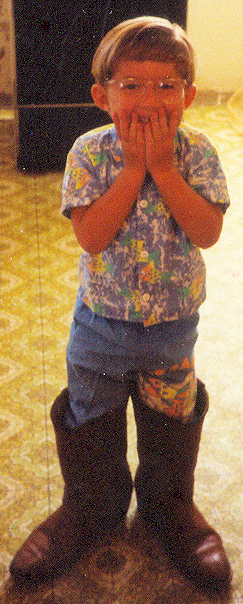 So when our child gleefully sang out “catch a tiger by the toe,” we cheered. Delighted by his parents’ approval, he stood up and clapped, too, as the three of us danced around the kitchen singing “catch a tiger by the toe” over and over. He had no idea, of course, why we were so proud of him — and relieved to see that the world in which he was growing up looked a lot different than the one we knew as children.
Lodi, like the rest of America, has come a long way since the days when I was jumping rope and playing dodgeball on the playground of the local elementary school. Incidents of discrimination, harassment, retaliation and/or hate violence still occur, but children of all colors play and study together in the fashion about which Dr. King dreamed in the same classrooms of the same schools I attended. Unlike us, today’s young Lodians participate in “Winter Festivals,” “Holiday Pageants” or similarly-titled events singing “The Dreidel Song,” secular and religious Christmas carols, Kwanzaa tunes, and celebrating the arrival of Winter Solstice with an appreciation of the traditions, beliefs, practices, and values of their neighbors. They enjoy breaks from school between quarters. The children marching around the Square last night, waving flags and singing patriotic songs, were a diverse group of youngsters who neither noticed nor cared that the skin color of the child marching next to him/her was different than his/her own.
Unfortunately, I was compelled to protest to the event’s organizers last year when the master of ceremonies told a homophobic joke that was completely inappropriate for and marred the festivities. But the good news is that, although he could not resist taking the microphone and announcing, “I’ll try not to say anything politically incorrect this year,” he did refrain from telling any similarly offensive jokes or stories last night. That’s progress.
Still, as I surveyed the crowd last evening, I could not help but feel some shame and disappointment about the fact that the group was not as diverse as I would have liked. For all the change that has transpired in Lodi — and similar cities throughout this country — much more remains to be accomplished.
But the Founding Fathers were wise and prescient, noting that America is a promise, not a product. The American dream — however you define it — is ever-evolving, adapting to societal changes, adjusting as we become more knowledgeable about and appreciative of our differences.
 Tonight I will again be playing my flute during the festivities at Lodi Lake, another local landmark. Again, I will remember the time I have spent there over the years, and the friends and family with whom I enjoyed those occasions. I’m sure that I will again consider the love-hate relationship I have with this town, what it represents, how it has impacted my life. But, when the celebration is over, I will come home to the only real home I have ever known. Yes, I have owned and resided in other houses, but none of them were ever home in the sense that this house has been and always will be. And not all of them were here in the village that is, in so many ways — good and bad — a little town that time seems so often to have forgotten.
And when my vacation is over, I will return to the work I love, reminding myself of the people and events that fueled my desire to become a lawyer and spurred me into civil right work. When I get discouraged about the pace at which progress is being made toward true equality, egalitarianism, and freedom for all, I will stop for a moment, and whisper to myself, as I have so many times since that day in 1989, “Eeny, meeny, miny, moe, . . . ” as a reminder of how far I — indeed, all of us — have already come.
9 Comments
Very beautifully written. I think all of us who grew up in a small town can identify with your article. Just like everything else in life, there is no positive without a negative. The simplicity of small town life sometimes prevents the people who live there from being as socially “aware” as those living in large cities. I know that when I was growing up in a small town, I felt like the whole world was passing our town by. I watched the news, and saw the social unrest, the Viet Nam war, Martin Luther King, John F Kennedy, Bobby Kennedy, Neil Armstrong and all the other amazing events of the 1960’s, but they seemed to have no affect on my town. I couldn’t wait to leave that small town and join the rest of the world! I suppose that seeing the social changes in small towns, even as slow as the process is, that’s how we know that we are progressing as a country.
Thank you for a great article.
Pams last blog post..How to Prevent Your MLM Opportunity from Appearing to be a Pyramid
A time where we were too young to fully comprehend the implications in what was going on in your country, indeed anywhere else for that matter, but which we have grown to know all too well, with both negative and positive thoughts surrounding each decade.
The American is but one dream among thousands from around the globe. In it’s infinite, yet short lived wisdom America has still many dreams and ideals to dream of and fulfill – “much more remains to be accomplished” as you say.
Wonderful – thanks so much for this well written and thoughtful story. Many perspectives were put into place and recalled once again. — Best Lucy.
Lucys last blog post..Researchers Find Yet Another Immune System Code
Pingback: bloggingzoom.com
A wonderful post capturing the good and the bad of how we’re evolving as a people in America. Like you, I can remember growing up in the 50’s and 60’s mostly in a small town in the south. I didn’t understand as a child why people acted the way they did towards others. Good people do things because that’s the way they’re taught though it doesn’t make it right.
We have come a long way and still have a long way to go in respect for one another’s differences. That’s what makes this country great and unique, our differences, and I have hope that we’ll figure it out and continue to find ways to accept each other.
Thank you for reminding us how we have learned and changed and showing us what we still need to do.
Blessings,
Very nice post. You seem to be so eloquent in whatever you write. It is really a writer’s gift. Keep posting. You have dedicated readers.
I didn’t understand as a child why people acted the way they did towards others. Good people do things because that’s the way they’re taught though it doesn’t make it right.
Cirtexs last blog post..How To Use Keywords Wisely
Pingback: PlotDog Press and Woof contest winners « So many books, so little time
People like you are the reason why your country will always be THE World leader, even if it is handicapped with leaders who are not admired universally.
I truly enjoyed this post.
Best regards
I really enjoyed reading this post, thank you. As someone who lives in the UK there are so many aspects of American life that are hard to make sense of from a distance. Your detailed account of small town life has helped to fill some of the gaps for me.
Joanna
Joanna Young´s most recent post: Simply The Best: Reminder