
My sister gave my mother one of those Hallmark books designed to hold the family’s history, as recorded by the grandmother. It was pretty and contained a lot of questions that the author was supposed to answer about his/her childhood, including the music, films, books, etc. that were popular then.
My mother didn’t think too much of the idea, apparently. When we were cleaning out my parents’ house after she moved into an assisted living environment, we found it.
You guessed it. Blank. Each and every page was as clean, unwrinkled and utterly devoid of any notations as on the Mother’s Day when my sister presented the book to her.
I have written previously about the austere circumstances of my parents’ upbringing during the Great Depression. Although she never said it aloud, I know what my mother was thinking. “We didn’t have time to worry about movies and music. We had to work. We were trying to eke out a living.” To her, that book was frivolous, superfluous. Unlike her daughter, my mother was not a writer. Oh, she was intelligent, articulate and extremely insightful. But her hands never touched a keyboard. They were too busy cooking, cleaning, sewing, gardening and, in her later years, crocheting. My parents told us what they wanted us to know.
And yet . . .
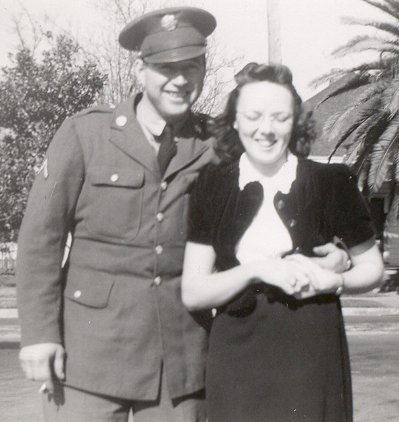 Imagine our shock when we found a scrapbook we had never seen before. A scrapbook full of my mother’s memories of an extremely difficult time in their lives: World War II. (That photo was taken on Washington Street right here in Lodi in 1943 when my father was stationed at Sharpe Army Depot in Stockton and my mother came from South Dakota for a visit.)
It was hidden away in the top compartment of the closet in my old bedroom, which has been MattieBoo’s room for more than five years now. After I moved out, that room became my mother’s sewing room and office. She had a sofa bed, television and desk there, along with her faithful Singer sewing machine (black with gold trim in a blond cabinet purchased in the early 1950’s before I was born — she used to tell us about the day the Singer salesman came to town and my father decided they should trade in her treadle machine for an electric model). The book was all the way on the back of the shelf . . . I had to stand on top of the step stool in order to reach in and pull it out.
When I stood up on my tippy-toes, reaching into the dark region of the closet, I instantly knew, as I used my fingertips to slide it forward and get a good grip on it, that I had never before seen the old-fashioned brown “Scrapbook.” The look on my sister’s face told me that she was just as surprised. Since she is eight years my senior, she sometimes remembers stories or people that I don’t recollect, but this was not one of those times.
We sat at my mother’s desk, mesmerized by the items glued to the pages and the notations placed next to them in a youthful version of the handwriting we knew so well. We examined the ration cards, Blue Star banner that my mother had displayed in the window, my father’s dogtags and all the other treasures contained there.
It’s hard to envision your parents as young lovers. But this was a scrapbook compiled by a young bride in her mid-20’s. After all, my parents were married in March 1941 and just one year later, my father received “greetings from the U.S. Government.” He served in the Army Air Corps in Australia and New Zealand while my mother waited for him at home with her parents on the family farm in South Dakota.
Earlier, we had surveyed the contents of her cedar chest. As a child, I happened upon bundles of letters stored there, but my mother promptly snatched them away from me. Sometime between that day and the day we found the scrapbook, my parents must have decided that those letters should never be read by their children because they were no longer in the cedar chest — or anywhere else in this house — by the time we were left to take inventory of all that they amassed during their lives. Gone forever, no doubt burned in the fireplace one winter evening to prevent the most private details of their relationship from ever being revealed.
I will never know for sure, but I suspect my mother might have forgotten about the scrapbook. Otherwise, I think she might have removed some of the cards and letters my father mailed from a variety of locales. My sister and I couldn’t resist a giggle or two as we read the messages. “Kenny wrote this mushy stuff?” I marveled, as she rolled her eyes at me. “I just can’t picture it,” I told her.
Would she have removed the telegrams included in the scrapbook? I wonder. But I’m glad she never did because my sister and I learned a great deal about our family history, as well as my parents’ relationship, when we saw the series of telegrams he sent as he worked his way back to South Dakota to resume married life with his young bride.
Over the first, declaring that the war was indeed over and he would be coming back to her, she wrote, in huge letters, “The happiest day ever.”
I live in a house that is filled with my family’s history, but I wonder from time to time what significance that history will have for my children — or my nephews. Sometimes I think about writing a narrative about it all, going from room to room, cabinet to cabinet, closet to closet, to detail the story behind each item and memorialize the events that have transpired in these rooms.
When I think about that scrapbook, I wonder what else is hidden away in the closets, cupboards, drawers . . . What will my children find in this house when I am gone and what will they learn about me or other members of the family via their discovery? What aspects of my personality or our family history will they learn about not by interacting with me every day over the years, but from clues contained in the artifacts I leave behind?
What’s in your closet? What do those items reveal about you or your family history?

14 Comments
As an avid scrapbooker, or at least formerly an avid scrapbooker, I had to come and comment. I was compelled to come and comment.
I used to be one of those scrapbookers who wanted to chronicle every moment of my life. One album a year–12 X 12 45 pages, at least.
Since I left home, I haven’t had anyone to scrap with. My albums have languished in the corner–unfinished, unstarted.
I’ve come to realize that by chronicling every moment, I will grow old with a housefull of scrapbooks with no room to enjoy the people in my life. And the valuable moments that I scrapbooked will be lost among the mundane things in life.
As much as I enjoyed making my albums, I see that there is beauty and elegance in simplicity and my time would be better spent valuing the people instead of being always lost behind a camera watching for that perfect shot to scrapbook.
I want to leave behind sweet memories of beautiful fellowship, not books that remind my loved ones of an obsessed photographer/scrapbooker who was never really ‘present’ at the family get together.
I want the kitchen table to be a reminder of pleasant conversations. That’s the family history I want my house to tell.
Thanks for your story! Our mothers seem quite a bit alike, both raised during tough times with that very evident work ethic. I have yet to move Mom and Dad into a care facility though … but I know that day will come. Meanwhile, I’ve taken over Mom’s photo albums because they were deteriorating so badly. She doesn’t care about saving the images for posterity, but I do. I don’t know what’s in their closets that I may find one day, but I’m not leaving my knowledge of family history — or my own — to chance. I’ve already begun sharing the pictures and the stories to the next generation, digitally. (I’ll keep my closet for clothes!)
Brenda Friedrich’s last blog post..How many cooks in the kitchen?
That is so cool! I wish I could find a hidden scrapbook from my mom’s earlier days. That must be really special to you.
:O)
I have my grandmother’s autograph book, all the letters my grandfather ever wrote to me, and a collection of coins from his travels during is military service.
As well as a collection of dishes and hats.
This entry was marvelous.
This was an awesome story! It really expresses the need for us all to save even the small momentos, cards etc for our own children and grandchildren to enjoy once we’re gone. Thank you for sharing this!
Lin’s last blog post..Sometimes Kids Can Drive Parents Nuts
A very touching story.
I don’t have any such scrapbooks from my parents. My memories consist only of remembered conversations with my mum and late father.
I would like to leave some history for my children. Writing a scrap book seems like a good idea.
fathersez’s last blog post..Business (and investment) opportunities arise when technology meets and improves on an old business practice
nice story, i used to have this scrap book from my great grandmom which i lost it when my house was burglarized 🙁
Writing way back then took the backseat but a scrapbook was a thing some really took time with. My great grandmother left one and we always look through it everytime relatives come over to visit.
Janie,
Great story. Wouldn’t it be something to fill in the blanks in that book to tell the story of the house? That scapbook was quite a find.
(I’m here via The Seventh Day)
SandyCarlson’s last blog post..Blog Your Blessings: Nothing
I really loved to read your post it was so touching and interesting. But you know sometimes it is better for children not to find anything. It depends in your case you found nice and positive things. When I went through letters and “scrapbooks” my mother had written or done (or my father’s letters) I wish I had never found them because all my illusions were gone !
BTW I am here for the 7th day
Janie – I loved this post. The memories we can learn from our parents and grandparents are so valuable in connecting the past to the present. It also helps when we’re in line to pass them onto our children and grandchildren. I’m in the process of doing some geneology research and it’s interesting when you find old records of ancestors. It gives you a piece of history you never had.
Pat R’s last blog post..Starfish and Humans – We All Need a Stranger to Come to Our Aid at Times
Really interesting makes me think we should all compile scrap books that can be looked at in the future
seriously, i enjoyed reading your entry. its like going back in time. my mother had also an array of stuff when they were still dating. but i had the pleasure of reading them when i was young. i was allowed to look at those stuff with them. =)
What a treasure! I have a couple of scrapbooks my great-grandmother made, but all they contain are poems she cut out and pasted. It is fascinating to see the check marks next to her favorites. I would love to have just one sentence written by her own hand though.
Renae’s last blog post..Confession