


My mother, Ethel, left this world on October 13, 2005, but she left her family long before that. She left us gradually, slowly inching further and further away until she finally retreated into her own little universe — a little corner of her own mind where we could no longer connect or interact with her. And eventually, I did something I never would have believed I could do: I wished that she would die.
For the last two years and three months of her life, my sister and I visited her every week. We always went together because having a companion made it a bit easier. We had each other to talk to about things as we sat at her bedside. Most of the time, though, we didn’t talk when it came time to leave. We would drive home in silence, both thinking and feeling the same things, none of which really needed to be verbalized because we had said everything there was to say on numerous previous occasions.
After every visit, I wished and prayed that it would be the last. Then I would feel guilty for wishing that, even though I knew that my mother was living out her worst nightmare on a daily basis and I was powerless to help her escape it. Thinking about it that way, I would reaffirm my hope for her death to come about, and so the cycle repeated itself over and over.
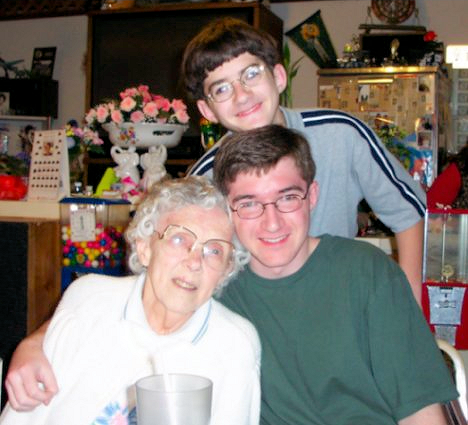
When I came home following each visit, I would tell myself that I just needed a few minutes to regroup as I strode toward my bedroom (which used to be my parents’ bedroom and then, after my father’s death, her bedroom). Settling down in front of the t.v., I would wake up two or three hours later with the realization that my visit with her had once again worn me out to the point that I had collapsed. BigBob and the kids learned to just leave me alone because “Mom just got back from visiting Nana” and they knew rest was what I needed.
The kids visited her regularly when she lived in this house and for the year that she resided in an assisted living facility. At that point, she was still ambulatory and conversant. Although her memory was fading and she was definitely becoming more frail, she could walk to the dining room for her meals, participate in activities, and visit with the other residents. Every Sunday, the boys and I took her out for lunch. She enjoyed getting out and eating food that was different than that served at the facility. It was the boys’ job to help her in and out of the car. They each took one of her arms, walking slowly with her to make sure that if she started to lose her footing, they could intervene.
“Most of all the other beautiful things in life come by twos and threes by dozens and hundreds. Plenty of roses, stars, sunsets, rainbows, brothers, and sisters, aunts and cousins, but only one mother in the whole world.”
~ Kate Douglas Wiggin ~
While she was still living here in her own home, her eyesight worsened, due to macular degeneration, to the point that she could not see well enough to dial the phone, so we programmed the numbers for her and she memorized the associated prompt. We thought, when she moved to assisted living, that taking the same phone with the same programmed numbers would mean she would still be able to make calls. Unfortunately, the act of moving the phone and change in her surroundings apparently caused her to lose the ability to use it. So she was never again able to call us. I remember distinctly the day that realization really “hit” me. I was at the office and I called her. When I hung up, I noted how long it had been since she had called me and then had to come to grips with the fact that I would never again pick up my phone and hear her voice at the other end.
The loss of simple little things that we take for granted are frequently the most devastating side effect of goodbyes.
Sometimes, we had to laugh or we would never have been able to cope. For instance, we went to the assisted living facility for her eight-sixth birthday celebration. It was fun! They played records and a lot of folks even danced. At that juncture, she was habitually reliving my father’s death and how hard it had been to say goodbye to him. It was a strange phenomenon . . . she talked incessantly about it as though it had just happened, saying, “I lost my husband, you know.”
On this particular day, she was sitting between my sister and I. She turned to me and said, “I lost my husband and it was so terrible.” I responded, “I know, Mother. He was our father.” Without missing a beat, she exclaimed rather loudly, “No! He wasn’t your father!” Several people, including our friends who had accompanied us for the party, heard her and burst out laughing. I said, “Mom, is there something you need to tell me? Is there a family secret you want to reveal after all these years?” and that made them laugh more. What else could we do?
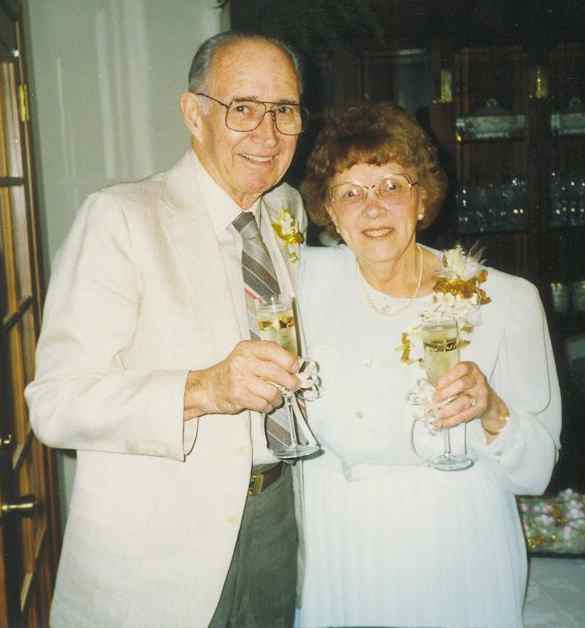
Another time, she pointed to their fiftieth wedding anniversary photo on her dresser and said, “That’s the guy I was dating!” Again, my sister and I said, “Yes, Mom, you married him. He was our father.” She spun around to my sister and said emphatically, “We never had any children!” So we just changed the subject. Folks with dementia or Alzheimer’s disease say and do all sorts of inappropriate things. You learn to be ready for the unexpected and take whatever they say in stride.
When she could no longer walk and quit eating, we had to place her in a facility that would provide total care. My whole life she had said, “I hate those places. People just sit there waiting to die. I never, ever want to end up in one of those places.” So you can imagine how much like Benedict Arnold I felt sitting in the office signing the admission forms.
What choice did we have? Neither my sister nor I had the training, equipment or financial resources to quit our jobs and take care of her in one of our homes. She would never have wanted that, anyway. She had desperately feared becoming “a burden” in her waning years and would be furious at the thought of disrupting our lives or careers. After all, she was the one who wanted a college education more than anything in life, but it eluded her because she graduated from high school in 1934 at the height of the Great Depression. Thus, she instilled in us the notion that a failure to complete our education was a life failure.
I reluctantly got her settled into what would be her final residence.
For awhile, she still remembered us and the boys, so they visited, too. But I always gave them the choice. Both came to the conclusion, in their own time, that they no longer wanted to see her in her debilitated state. Both expressed a desire to live with their memories of her in better days and I honored their request, telling them, “That’s fine because that’s the way Nana would want you to think of her.” My sister and I could not make that choice, though. We had to continue visiting her long after she had no idea who we were.
When she finally died, I didn’t have a lot of tears to shed. When I wrote my initial post four months later, I noted “that made me feel guilty, too. And still does.”
A year passed and those tears never came . . . I have now resigned myself to the fact that they never will.
A long, slow death from Alzheimer’s or dementia is among the cruelest for the patient’s family members. Ronald Reagan, in his 1994 letter announcing his diagnosis, acknowledged what lay ahead for his beloved Nancy, who called it “the long goodbye.”
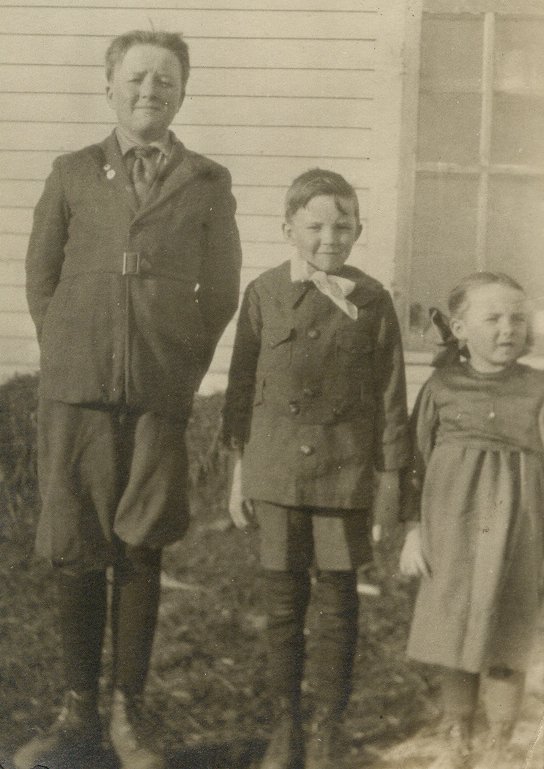
The patient doesn’t suffer, for the most part. My mother’s physician repeatedly assured us that she lost the mental capacity to appreciate her circumstances. She was in a mental time warp where she and her two older brothers (pictured here with her when she was five years old . . . see a resemblance in my profile photo taken when I was four?) were walking to Sunday School across the South Dakota prairie. Once, when my sister and I arrived to visit, she told us that her mother, who died on April 29, 1971, had just visited her. And for quite awhile, after she finished reliving his death, she talked about our father as though they were young. She’d tell us that he had just left and would be back soon. My sister and I would just look at each other and say, “Don’t we wish?”
She talked incessantly, but we could not piece the words together into coherent form and, even if we tried, by the time we responded to her she had moved on to another jumbled thought.
For a long time, after she could no longer recognize us and say our names without prompting, she would get very excited when we told her who we were. She’d look at me with a brief flash of recognition, saying, “Are you Janie?” I’d remind her that I was her daughter, but within a few seconds she would forget again.
Intellectually, it is hard to become too distraught about the death of a person who has spent nearly 89 years on this planet, after all. It isn’t the same as when a young child dies tragically or a middle-aged person is diagnosed with a terrible form of cancer and dies quickly, leaving behind children and a spouse. After all, this is the way the cycle is supposed to work, right? We are supposed to bury our parents and, in turn, our children are supposed to care for us in our final days, and so on and so on . . .
So I guess that I really shouldn’t have been surprised to find that, when she died peacefully after hearing the Scriptures and words of comfort, I didn’t have a lot of mourning left to do. She lived a long, purposeful, meaningful life doing a lot of things that brought joy to her and her family. She lived independently until she was 85 and a half years old.
I was happy when she was finally released from the steady debilitation that punctuated her last couple of years. I don’t lose any sleep at night wondering where she is now. She is reunited with our father and the rest of her family. I’ll see them all again.
What I came to realize is that it truly was a “long goodbye.” By October 13, 2005, the day her shrunken little body finally surrendered and followed her mind into eternity, there just wasn’t any mourning left to do because I had grieved her leaving in the same way that she left, i.e., a little bit at a time, slowly, gradually, inch by inch.
It was a very different experience than losing my father, who was sick for many years, but had long periods of good health between bouts. And he never looked or acted his age, never became senile at all, remaining perfectly lucid until the very moment he died as I stood at his bedside talking to and reassuring him.
And that’s why I felt so disconnected and guilty about it . . . wondering when my mother’s death was going to “hit” me, so that I could go through those five stages of grief that Elizabeth Kubler-Ross educated us about.
Finally, I understood that I went through those stages at such a slow pace, so gradually, that I didn’t even realize I was doing it. I just put one foot in front of the other, dealing with the situation as best I could. In reality, I was saying my goodbyes to my mother but didn’t comprehend that I was doing it. There was no final emotional catharsis. Peggy Lee asked musically, “Is that all there is?” and the psychologically disconcerting answer is “yes.” That was it. That’s how it works.
Perhaps that’s the ultimate “punch in the gut” that Alzheimer’s delivers to the patient’s family members: Not only does it rob you of your loved one, it also robs you of the chance to grieve in what society generally perceives as a normal, healthy manner. It robs you of the chance to say “goodbye” in the way we have come to expect under other circumstances.
Instead, you experience both the loss of your loved one and your grief about that . . . in slow motion.
On this Mother’s Day, if you are lucky enough to still have your mother with you, go call or visit her. Take her some flowers. Take her to lunch. Enjoy her company and conversation while you can. Give her a hug and a kiss. Thank her for all she’s done for you over the years because “[a] mother is she who can take the place of all others but whose place no one else can take.”
Inspired by the Sunday Scribblings Prompt: Second Chance which provided me with a second chance to share this article in honor of Mother’s Day.
16 Comments
After reading your account of what you went through with your mother and her situation, I realize I need to be more thankful that my mom, at 86, although physically limited by her health, pretty much has her intellect intact. One of the good things about moving in with her is the quality time we would not otherwise have had. Thanks for a very moving post, and for your kind words on my blog.
P.S. I have been through Britton SD many times. I have family who farm in ND just over the state line north of town. We have eaten Sunday dinner in the little cafe on main street more than once. Small world.
What a touching goodbye. In fact, both entries were but this one in particular, just pulled at my heart strings. Thank you for sharing something so personal. Yet, I know for someone out there that has experienced the same, it has probably helped them too.
I enjoy reading your Blog. See you next week! 🙂
Just catching up on some blog reading and wow, this post reminds me why I need to keep up. Beautiful, touching post.
Wow…you are so open with your past and your mom. My mother is still alive and I feel like I have neglected her at times. I thought numerous times we would lose her, but we haven’t and I should be more aware of her and appreciative than what I am. I love her a lot. Thanks for the post and reminding me what is important on this significant day.
Jane, thank you for sharing that moving story with us, that must have taken a lot to be so honest and open.
You’ve so perfectly descibed this process, which we’re going through right now with my mother in law. Thank you for sharing this story so beautifully.
Thank you, Janie, for posting about your mom today. My mom is 82 and is still here with us, thank God… and she seems to be doing just fine.
I can relate to your feelings of guilt over wishing your mom would go… when my dad got so sick and we had to put him into a facility, he was just so miserable… but we couldn’t do it any other way. All I could do was pray for a happy death for him, a peaceful one with no pain, and that’s how it went… and we were there with him. I have no regrets about that.
Thank you for sharing your feelings- you are an inspiration, truly.
happy Mother’s Day to you…
This so echoes much of what I have experienced first with my father and now 15 years later with my mother.
I felt terrible guilt at my inability to mourn and grieve for my father *appropriately* until I realised I had been doing it day by day for the last 18 months while I was nursing him.
The situation with my mother is similar to that with your mother – a slow gradual decline.
In her shadow world she has time warped many a time, talking of my father and her brothers as if it were 30 years ago. She has also had a *liaison* with my partner which tore her up with guilt and is now contemplating going to Paris with me.
I hope you are having a wonderful Mothers Day.
Happy BYB Sunday
Janie, in it’s own unique and poignant way, this is a wonderful Mother’s Day tribute to your mother and to your relationship with her. I am glad you have come to terms and to an understanding of your inability to grieve as you felt you were supposed to. Of course, you grieved, in a far more painful and protracted way. I hope you have been able to totally put aside your guilty feelings about hoping that her death would come. I have no doubt that she wished for that too, and probably more fervently than you did.
Thank you for sharing with such honesty and detail. I feel sure that reading your story and your feelings will bring aid and comfort to others.
Enduring to the end takes on such new meaning when you factor in the ravages of age and related illness doesn’t it? Thank heaven we have a lifetime of wonderful memories to help us balance the loss. Thanks for such a tender post.
Hugs,
Holly
Here via the Carnival of Family Life. 😉
My grandmother spent the last six months of her long life (nearly 93) in a nursing home. Her body was very frail, but her mind remained sharp. She was my talking calendar, because she reminded me of things I had to do all the time.
It was so hard to sit there chatting with her, and watch her fellow residents stare off into space or just babble.
It was especially hard to watch “the children,” some in their 70’s and exhausted, after they visited.
They were so sad to see their parents reduced to such an existence.
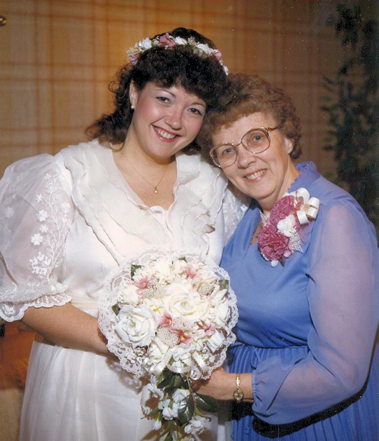
Your mother was a lovely woman, and you made a pretty bride.
Thanks for sharing,
Frances
What a nice tribute to your mother on Mother’s Day. It was obviously very hard for you to let her go, and you shouldn’t feel any guilt about wanting her to be able to move on from this life. There were definitely better things waiting for her.
hi janie,
thanks for the very honest sharing, it gave me and definitely a lot of other people comfort.
you’re an inspiration, keep it up!
-rob
Janie, your account of this very difficult time for you was beautiful. So very touching. So very moving. I’m sure your mother, before she was no longer available, was so proud of what a special, gifted daughter she had.
Janie, beautifully written. I understand; my father suffered from Alzheimers and talked about his brothers all the time. My mother, however, was absolutely miserable (no dementia) her last 6 months, it was a blessing to see her removed from her dread of walking up each day. Two weeks before we died, she barely reacted to our visit, too drained at that point to react in her normal exuberant way that we took the time to drive the four hours to see her. The last week she was too ill from an infection to stay awake more than a moment at a time. I shed some tears, but like, you, most of my grieving was done in slow motion before. You wrote about it in a way others will understand, I think.
Thank-you for sharing your story. It is very difficult to express these things in candid detail, yet it helps others in so many ways.
Best Regards,
Kyle
http://www.thehomecaredirectory.com